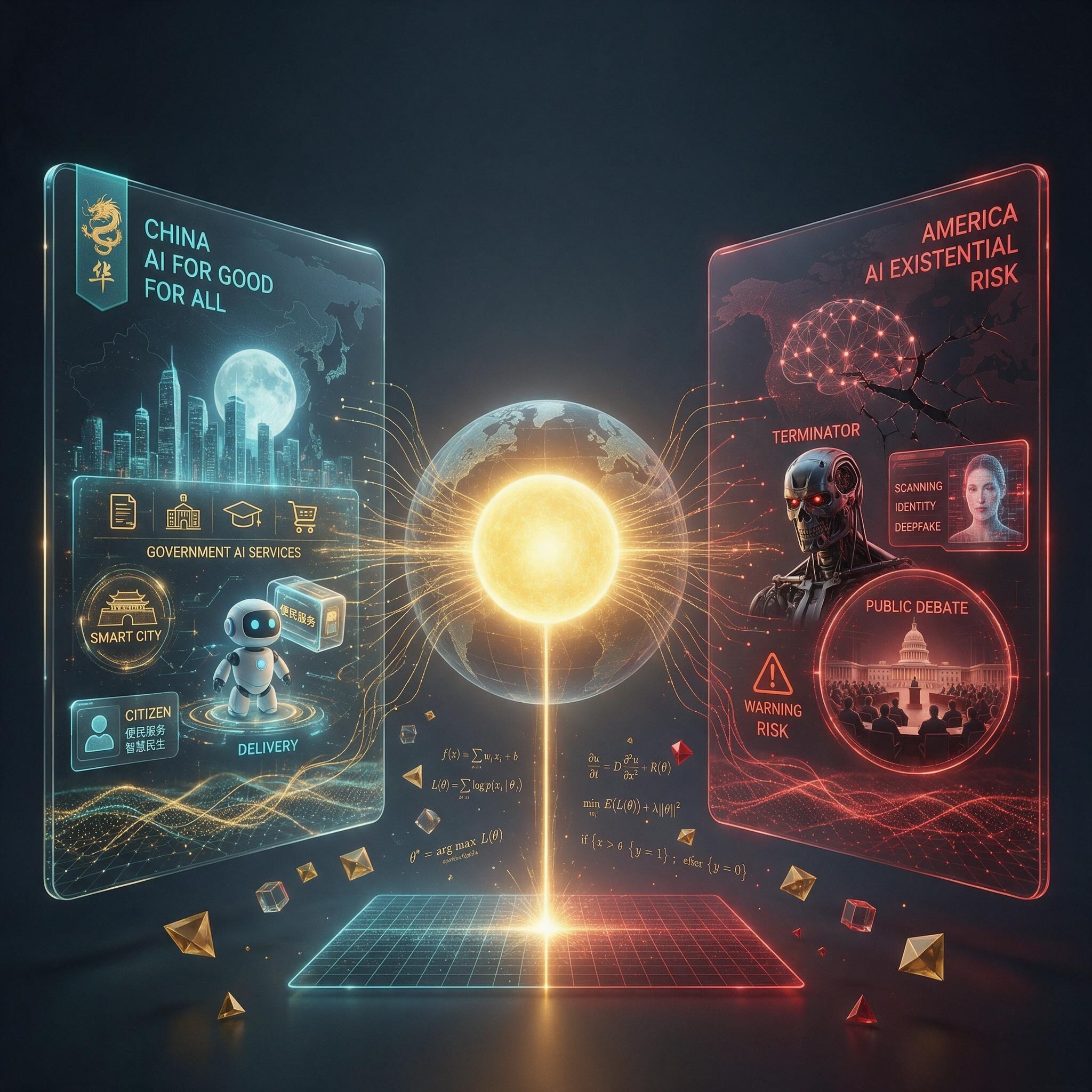
Unlike in the United States, virtually no one in China is publicly worrying that humanity will be wiped out by artificial intelligence in the near future.
In China, citizens access local government services through digital AI civil servants; students receive instant feedback on their written assignments by simply uploading a photo; hotel guests receive packages delivered directly to their doors by robots.
The widespread adoption of artificial intelligence in China today confirms that the country warmly embraces this technology.
A Morgan Stanley survey released on Monday revealed that 80% of Chinese respondents use AI at least once a week—a rate significantly higher than the 54% recorded in the US.
Even as American tech executives and researchers call for a slowdown in AI development, citing existential threats to humanity, Chinese society remains remarkably unconcerned.
Remarks by Zhou Jingquan (a 22-year-old business administration student in Beijing) capture this sentiment: "This technology was created to serve humanity; it shouldn't be viewed as something to fear, but rather as something that brings great convenience to our lives."
Zhou added that the government possesses full capacity to manage any associated risks.
Zhou's comments echo those of numerous individuals interviewed by CNN this week, highlighting a stark contrast in awareness between Chinese and American societies, as well as differing levels of trust in their respective governments' ability to manage potential risks posed by technology.
Ju Su, head of data analytics at tech consulting firm Omdia, stated: "In the US, there is a prevailing view that without whistleblowers, big companies could evade accountability or oversight due to weak government regulation. In China, however, there is very strong public confidence that if anything goes wrong, the government will step in."
Su also pointed to variations in AI exposure, public discourse on technology, and broader cultural and historical contexts as key factors behind this divergence.
In a market research survey by Ipsos earlier this year, 83% of Chinese respondents viewed AI-powered products or services as appealing, whereas only 33% of Americans felt the same way.
Similarly, a survey by marketing consultancy Edelman showed that 86% of respondents in China expressed trust in their government to do what is right, compared to just 39% in the United States.
A distinct difference between the two nations lies in their political systems; while whistleblowing is common in the US and political debates often grow contentious, China's top-down power structure allows the single-party state to set rules without facing overt public criticism.
Shi Hongchao (a 51-year-old from Liaoning province in northeastern China) remarked: "Everyone I know says AI has already entered every aspect of our lives. Everyone is talking about it or using it; at this point, stopping it seems virtually impossible."
In China's fiercely competitive market, tech companies have aggressively launched free chatbots and integrated AI features directly into apps people already use daily.
Industries ranging from cinema and e-commerce to manufacturing are embedding this technology, allowing gains in productivity and convenience to speak for themselves.
Po Xiao, a researcher and founder of the Hello China Tech newsletter, noted: "The majority of people in China experience AI first as an affordable product and only later as a debate. When the technology demonstrates itself as a useful, low-cost service, people evaluate it based on what it does for them rather than how it might harm them."
This stands in stark contrast to the US, where industry leaders and researchers have expressed profound anxiety over the rapid pace of AI development and its potential existential risks to human existence. China, as a fellow AI superpower alongside the US, has been conspicuously quiet on the matter. Xiao explained: "Chinese warnings are quieter and use different vocabulary; the primary framework focuses on loss of operational control, misuse, and social disruption, rather than the extinction of humanity."
Chen Yixin, head of China's state security apparatus, published an article last Sunday detailing the necessity of integrating artificial intelligence as a strategic industry for national economic development, while outlining the broader risks of the technology from Beijing's perspective. Beyond the recognized threats from adversarial actors using AI for cyberattacks, disinformation campaigns, and espionage, Chen warned that the technology could destabilize society and jeopardize China's political security.
He also pointed to the risks posed by monopolistic actions from certain countries—a clear reference to US export controls.
Xiao further explained that instead of open letters and public debates about AI safety risks, much of China's AI governance occurs behind the scenes through corporate compliance with official technical standards, safety assessments, and administrative filings.
The development trajectory of Chinese companies also differs from their American counterparts, reflecting distinct priorities and constraints. While Chinese labs have rapidly narrowed the gap with leading US firms like Anthropic and OpenAI, their models still lag behind the most advanced American systems, partly due to limitations in computing power and capital availability.
Liang Wenfeng, founder of DeepSeek, told investors during a leaked conference call in July that the widest gap between Chinese and American labs stems from access to cutting-edge AI processors required for training models—due to US sanctions—alongside lower capital investment levels.
Chinese firms face stronger commercial incentives to monetize and generate revenue, which may keep them less focused on developments that carry extreme or existential risks.
Su from Omdia noted: "The US is eager to push boundaries further. In China, there may be less emphasis on leading capability and more focus on how to make AI more productive and commercially viable."
China's technological advancements have coincided with rapid economic growth and the country's rising global prominence over recent decades. As the domestic AI industry expands, many citizens view this progress as another testament to China's technological success.
Su added: "There is a strong pro-AI culture in China; technology has always been regarded as a source of national pride."
This perception contrasts sharply with the US, where skepticism toward big tech and government has grown alongside opposition to AI data centers.
Over the past decade, Chinese technologies—from smartphones and electric vehicles to batteries and supercomputers—have increasingly matched or surpassed their American counterparts.
For many in China, this trajectory has created an expectation that new technologies will naturally bring economic benefits, prosperity, and national strength.
Grace Shao, a tech researcher and founder of the AI Proem industry newsletter, stated: "Ordinary citizens have experienced the economic benefits, prosperity, and convenience that technology has brought them, so there is an unspoken assumption that AI will do the same."
Chinese citizens naturally look to their government for protection. The state has repeatedly demonstrated its willingness to exert control over the country's most powerful corporations. In 2020, Beijing launched a historic regulatory crackdown on its largest tech, gaming, and private education hubs, erasing over $1.5 trillion in market value.
Shao noted: "There is an inherent trust among the public that the government will once again act as a parental figure to draw boundaries and establish guidelines for this new technology."
Shi from Liaoning is among those who believe the benefits of AI far outweigh the concerns, asserting that AI development should not be halted simply because it carries risks: "I believe we must continue investing more strongly in AI and protect its development. Ultimately, restricting technology does not guarantee stopping its progress. China is a vast country with compelling reasons to prioritize AI development."
Source: CNN (https://www.cnn.com/2026/09/17/tech/china-ai-debate-intl-hnk)
Why China is Less Concerned About an AI Dystopia Compared to the US

Rebaz Ahmed
Article author